
Technical Knowledge Center
Everything engineers need to specify calcium silicate board: composition, thermal conductivity, R-value, temperature limits, mechanical properties and the complete technical data sheet for every density from 250 to 1200 kg/m³.
Material
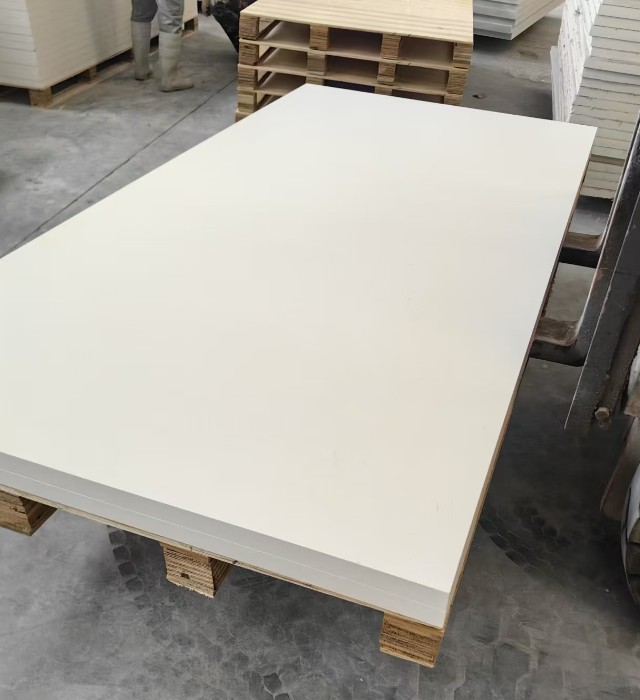
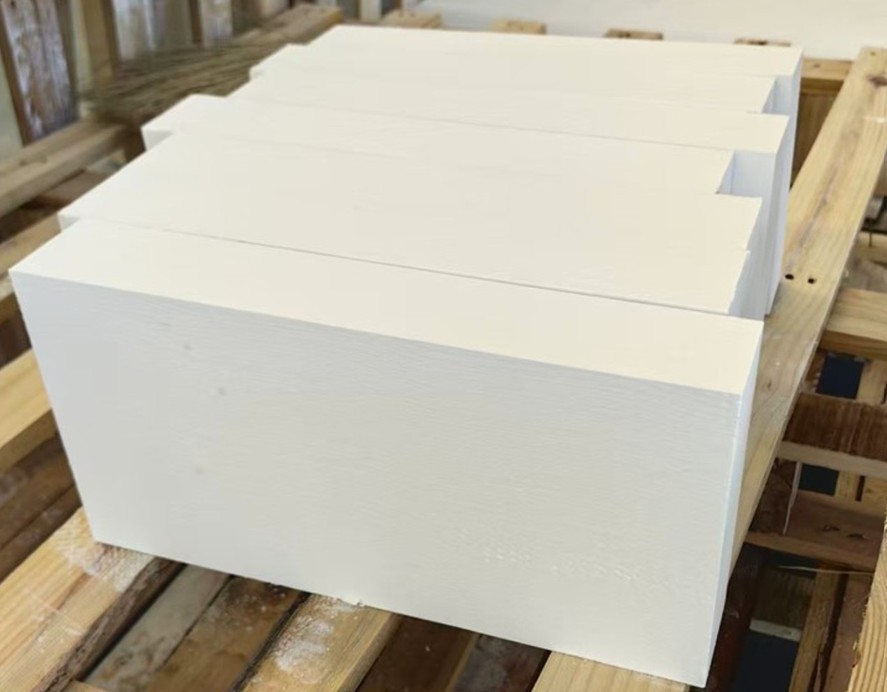
Calcium silicate board is a rigid, non-asbestos thermal insulation material based on xonotlite (6CaO·6SiO₂·H₂O). It is manufactured from siliceous and calcareous raw materials with reinforcing fibres, then autoclaved into a stable crystalline structure.
The result is a lightweight yet strong board that combines low thermal conductivity, high temperature resistance up to 1100°C and excellent dimensional stability — ideal for high-temperature insulation and passive fire protection.
Properties
0.14–0.23 W/m·K at 800°C — strong insulation.
Service up to 1100°C depending on grade.
Compressive strength up to ≥23 MPa.
Low shrinkage under thermal cycling.
A1 non-combustible, non-asbestos.
Low-density grades for easy handling.
Thermal Performance
Thermal conductivity (λ) measures how readily heat passes through the board — the lower the value, the better the insulation. The chart below compares λ at 800°C across grades. R-value (thermal resistance) increases with thickness, so a thicker board of the same grade insulates more.
Thermal Conductivity at 800°C (W/m·K) — lower is better
Values are nominal at 800°C mean temperature. To estimate R-value: R ≈ thickness (m) ÷ λ (W/m·K). Conductivity rises with temperature; request full λ-vs-temperature data for design calculations.
Technical Data Sheet
Complete specifications for every grade from 250 to 1200 kg/m³, in metric and US units. Click a density to open its product page.
| Density | Grade / Use | Max Service Temp | Compressive Strength | Flexural Strength | Thermal Cond. (800°C / 1472°F) |
|---|---|---|---|---|---|
| 25015.6 lb/ft³ | Ultra Insulation | 1050°C1922°F | ≥ 1.0 MPa≥ 145 psi | ≥ 0.55 MPa≥ 80 psi | ≤ 0.165 W/m·K≤ 1.14 BTU·in/hr·ft²·°F |
| 30018.7 lb/ft³ | Industrial Insulation | 1100°C2012°F | ≥ 2.0 MPa≥ 290 psi | ≥ 1.2 MPa≥ 174 psi | ≤ 0.170 W/m·K≤ 1.18 BTU·in/hr·ft²·°F |
| 65040.6 lb/ft³ | General Purpose | 1000°C1832°F | ≥ 5.0 MPa≥ 725 psi | ≥ 3.0 MPa≥ 435 psi | ≤ 0.19 W/m·K≤ 1.32 BTU·in/hr·ft²·°F |
| 80051.2 lb/ft³ | N-17 Carbon Fibre | 1100°C2012°F | ≥ 21 MPa≥ 3045 psi | ≥ 7.6 MPa≥ 1102 psi | ≤ 0.14 W/m·K≤ 0.97 BTU·in/hr·ft²·°F |
| 85053.1 lb/ft³ | N-14 Structural | 1100°C2012°F | ≥ 14 MPa≥ 2030 psi | ≥ 6.1 MPa≥ 885 psi | ≤ 0.16 W/m·K≤ 1.11 BTU·in/hr·ft²·°F |
| 98061.2 lb/ft³ | Thermal Shock | 1100°C2012°F | ≥ 15 MPa≥ 2175 psi | ≥ 7.0 MPa≥ 1015 psi | ≤ 0.22 W/m·K≤ 1.53 BTU·in/hr·ft²·°F |
| 102063.7 lb/ft³ | Molten Aluminum | 1100°C2012°F | ≥ 17 MPa≥ 2465 psi | ≥ 8.5 MPa≥ 1233 psi | ≤ 0.23 W/m·K≤ 1.59 BTU·in/hr·ft²·°F |
| 120074.9 lb/ft³ | High Strength | 1100°C2012°F | ≥ 23 MPa≥ 3335 psi | ≥ 15 MPa≥ 2175 psi | On request |
All grades are non-asbestos and A1 non-combustible. Density tolerance ±10%. Continuous service temperature for the 800–1020 kg/m³ grades is 1000°C (1832°F); 1100°C (2012°F) is the maximum / peak service temperature. The 650 kg/m³ grade is made-to-order; values are indicative and confirmed on request.
| Component | Low Density | High Density |
|---|---|---|
| SiO₂ | 52 Min | 50 Min |
| CaO | 40 Min | 35 Min |
| Al₂O₃ | 0.3 Max | 1 Max |
| Fe₂O₃ | 1.0 Max | 0.5 Max |
| Loss on Ignition | 7 Max | 7 Max |
Values in %. Low density = 250–650 kg/m³; high density = 800–1200 kg/m³.
| Family | Length × Width | Thickness |
|---|---|---|
| Low Density | 1210×1210 · 1220×1220 · 1230×1000 · 1230×500 · 1260×600 · 1080×950 · 1000×500 | 10–100 |
| High Density | 1230×1230 · 1250×2500 · 1200×600 | 6–160 |
Customized sizes and shaped products available upon request.
Production
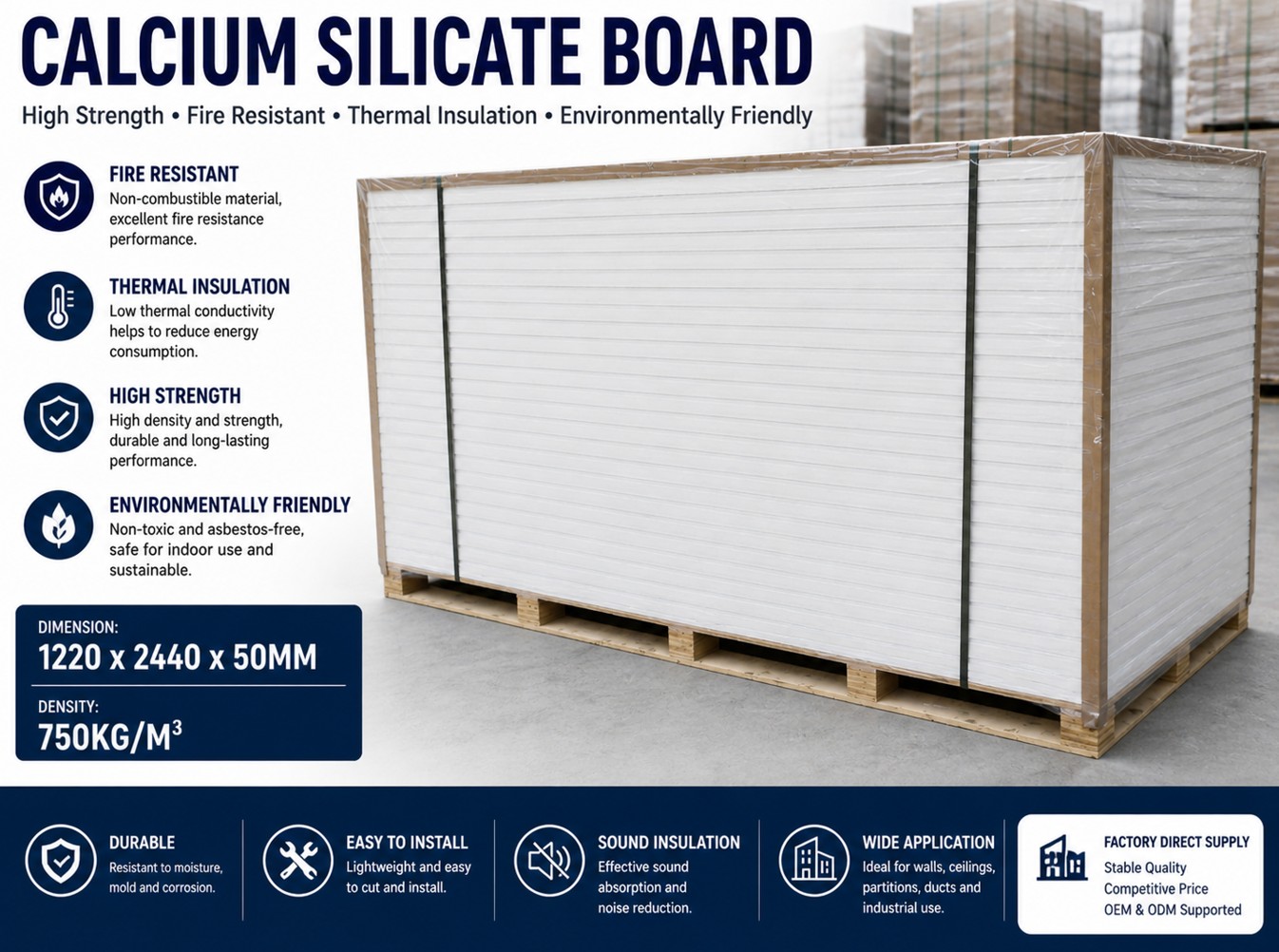
Production follows controlled steps: mixing siliceous and calcareous raw materials with reinforcing fibres, forming the slurry, high-pressure autoclaving to grow the xonotlite crystal structure, then drying, surface finishing and CNC machining to final dimensions.
This in-house process gives consistent density, dimensional accuracy and repeatable thermal performance batch to batch.
Read more on the blog →Standards
Manufactured without any asbestos content.
Inorganic material, reaction-to-fire class A1.
Controlled bulk density across batches.
CoC and inspection reports on request.
FAQ
Send your temperature, load and thickness requirements — our engineers will recommend the grade and provide full technical data.
Ask Our Engineers →